2 hours: St. Vitus Cathedral (45–60 min) + Golden Lane (30 min) + Old Royal Palace (30 min). This covers the three buildings most people remember afterward.
Half day (4 hours): Add St. George's Basilica (20 min) and Lobkowicz Palace (45–60 min). Lobkowicz needs a separate ticket ($16, or €35 combo) but has a collection unlike anything else in the complex — original Beethoven manuscripts and Habsburg armor.
Full day: Everything above plus the Royal Garden (open April–October, free, 30–45 min) and the National Gallery in Prague Castle (separate entry, 1–2 hours for art lovers).
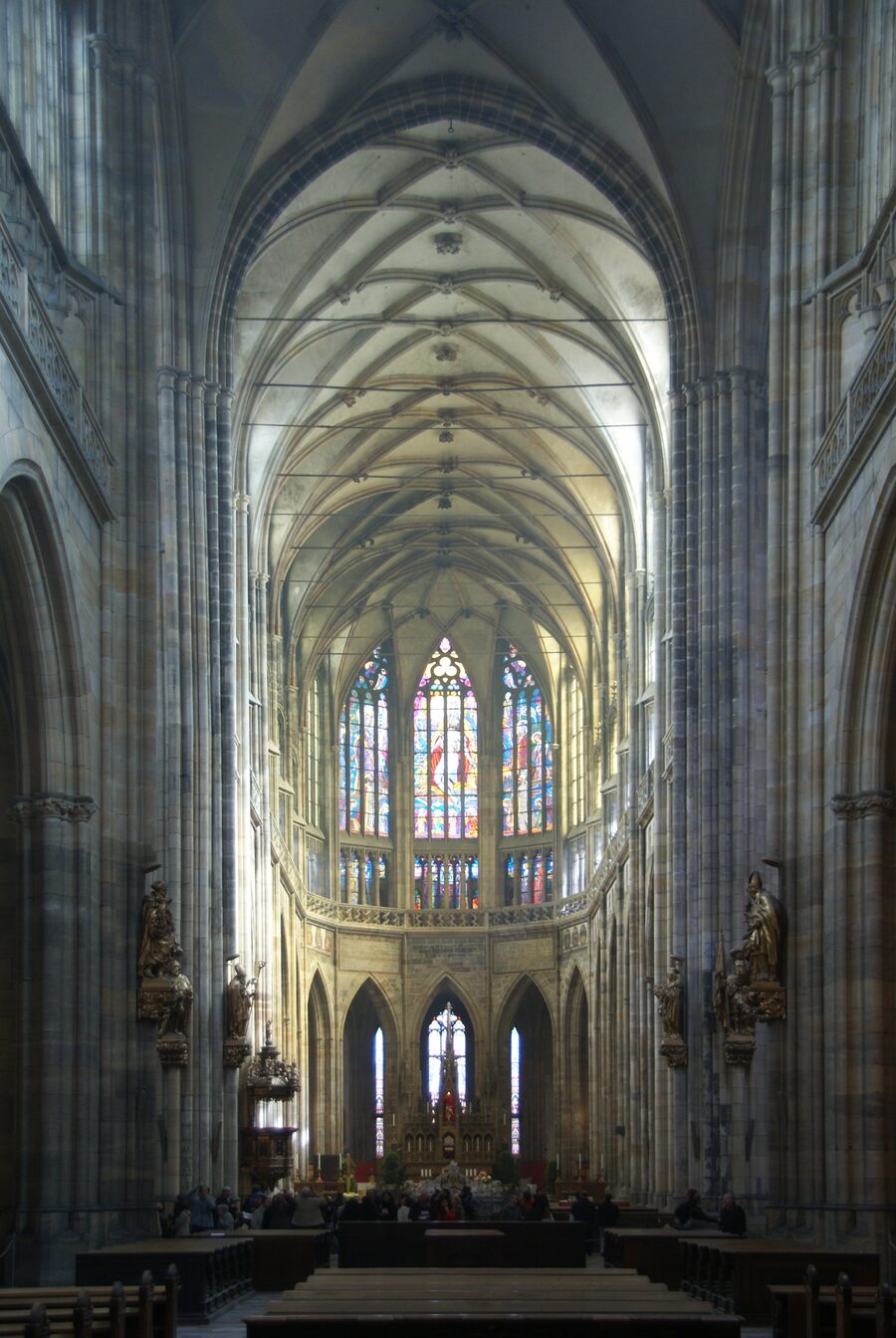
St. Vitus Cathedral
Construction started in 1344 and wasn't finished until 1929 — nearly six centuries of building, which explains why the nave reads Gothic and the rose window reads Art Nouveau. The cathedral is the burial place of Bohemian kings and Holy Roman emperors, including Charles IV, who ordered the original construction. The crown jewels are kept here (in a room that requires seven keys held by seven different officials to open).
The Mucha window — designed by Alphonse Mucha in 1931 and depicting Sts. Cyril and Methodius in his characteristic poster style — is in the third chapel on the north side. The St. Wenceslas Chapel (entry restricted, you view it through a gate) has walls encrusted with 1,345 semi-precious stones and holds the saint's tomb. The south tower is open for climbing: 287 steps, panoramic views, and close-up access to the cathedral bells.
Notable inside
- Mucha stained glass window (1931)
- St. Wenceslas Chapel (semi-precious stone walls)
- Royal crypt (tombs of Bohemian kings)
- Great South Tower (287 steps, city views)
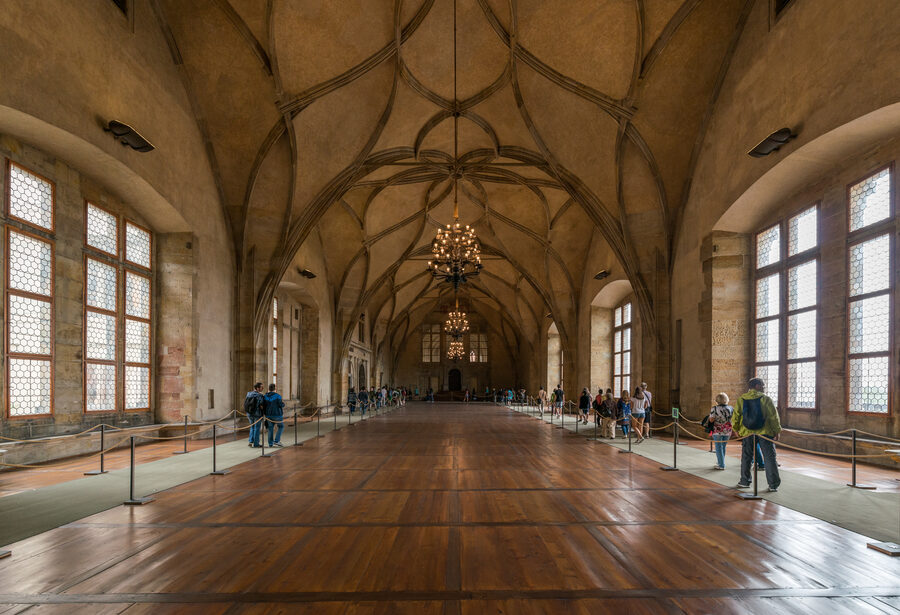
Old Royal Palace
The palace served as the royal residence from the 9th century to the 16th, when the Habsburgs moved their court to Vienna. The centrepiece is the Vladislav Hall (1493–1502) — a 62-metre-long throne room with a vaulted ceiling so wide that knights once rode horses inside for indoor jousting tournaments. The ramp at the far end (rather than stairs) was specifically built for mounted entry.
Below the hall, the Story of Prague Castle exhibition traces the site's history through artefacts, models, and documents across 12 chronological rooms. It covers the full span from the 9th-century fortifications to the 20th century. This is the most substantial museum in the complex and takes 30–45 minutes on its own. The room where the 1618 Defenestration of Prague was plotted — two Catholic governors were thrown from a window — is on the same floor.
Notable inside
- Vladislav Hall (62m, jousting ramp)
- Story of Prague Castle exhibition
- Room of the Defenestration (1618)
- All Saints' Chapel (separate room)
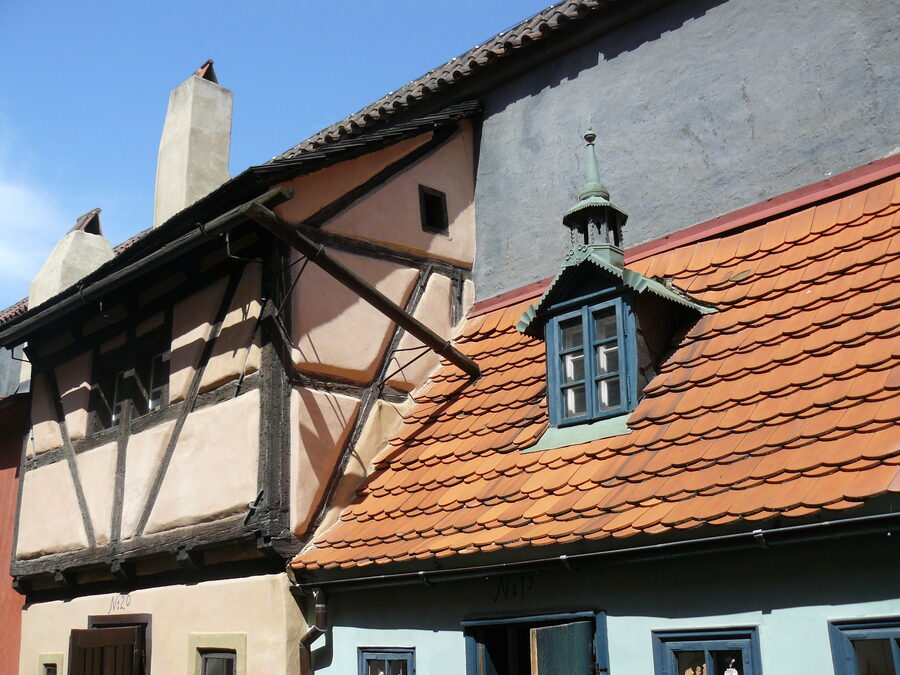
Golden Lane (Zlatá ulička)
A row of tiny, brightly painted houses built into the castle's northern fortification wall in the 16th century, originally for castle guards and craftsmen. Each house is about 3–4 metres wide. The lane gets its name not from alchemists (a later myth) but from goldsmiths who worked here in the 17th century.
House No. 22 was rented by Kafka's sister Ottla and lent to Franz Kafka for writing from November 1916 to April 1917. He wrote several short stories here, some of which appear in the collection A Country Doctor. The house is now a small gift shop with a plaque. The lane also includes the Daliborka Tower at its eastern end — a medieval prison tower with an exhibition of torture instruments used in the castle dungeons.
Notable inside
- No. 22: Kafka's sister's house (1916–17)
- Houses with period room reconstructions
- Daliborka Tower (former prison tower)
- Medieval weapons exhibition upstairs
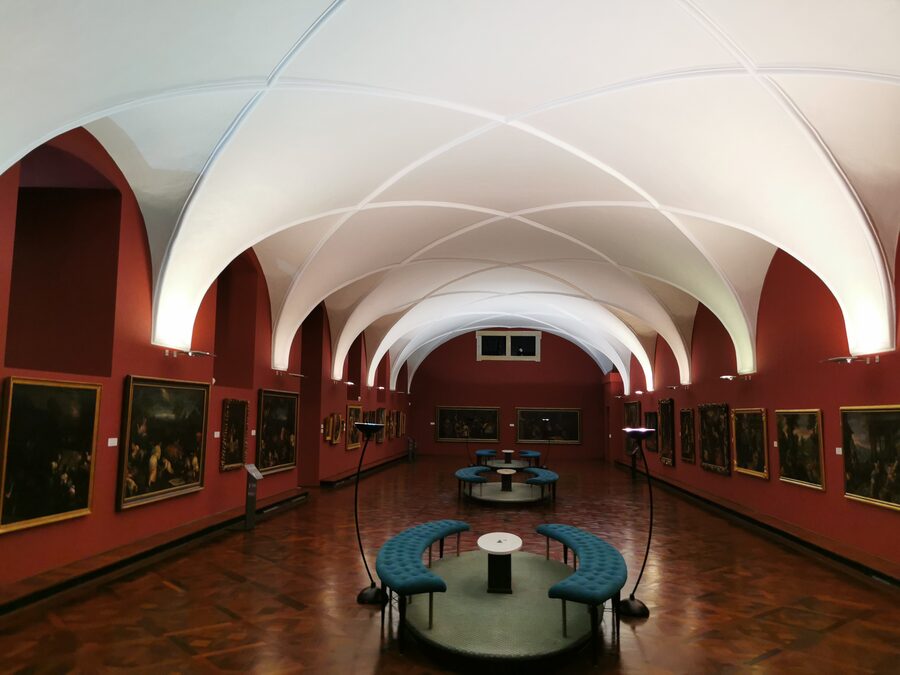
St. George's Basilica
Founded in 920 AD and rebuilt in its current Romanesque form in 1142, St. George's is the oldest surviving church building in the castle complex — roughly four centuries older than St. Vitus. The exterior is Baroque (the red-and-cream façade was added in the 17th century), but the interior is austere Romanesque: white stone walls, rounded arches, plain columns, and very little decoration. It's a striking contrast to the Gothic excess of St. Vitus next door.
The basilica holds the tomb of Princess Mlada (d. 994), who founded the attached Benedictine convent — the first female convent in Bohemia. The crypt beneath the presbytery contains the remains of several other early Přemyslid rulers. Chamber music concerts are held here regularly, and the acoustics are considered excellent for Baroque repertoire.
Notable inside
- Romanesque nave (12th century)
- Tomb of Princess Mlada (994 AD)
- Přemyslid royal crypt
- Chamber concert venue (check schedule)
Lobkowicz Palace
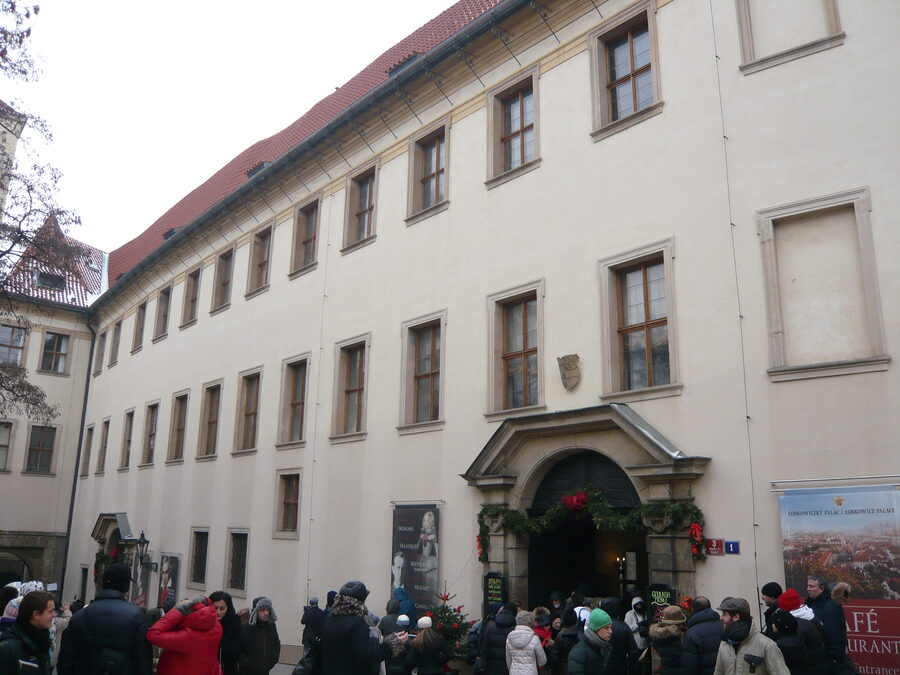
The only privately owned palace inside the castle complex, still held by the Lobkowicz family. It was confiscated twice — by the Nazis in 1939 and by the Communists in 1948 — and returned to the family in 1990. The collection reflects 600 years of patronage: it includes original handwritten scores by Beethoven (the Eroica Symphony and others), Mozart letters, two Bruegel the Elder paintings, Canaletto views of London, and a 16th-century Bellini.
The audio guide is narrated by the Lobkowicz family themselves, which gives it a character the castle's official guides lack — they tell family stories about specific objects. The café on the ground floor has the best castle views in the complex (and real coffee). Entry is $16 alone, or included in the €35 castle + Lobkowicz combo ticket.
Notable inside
- Beethoven Eroica manuscript (original)
- Pieter Bruegel the Elder paintings
- Canaletto London views
- Habsburg armor and weaponry
Royal Garden
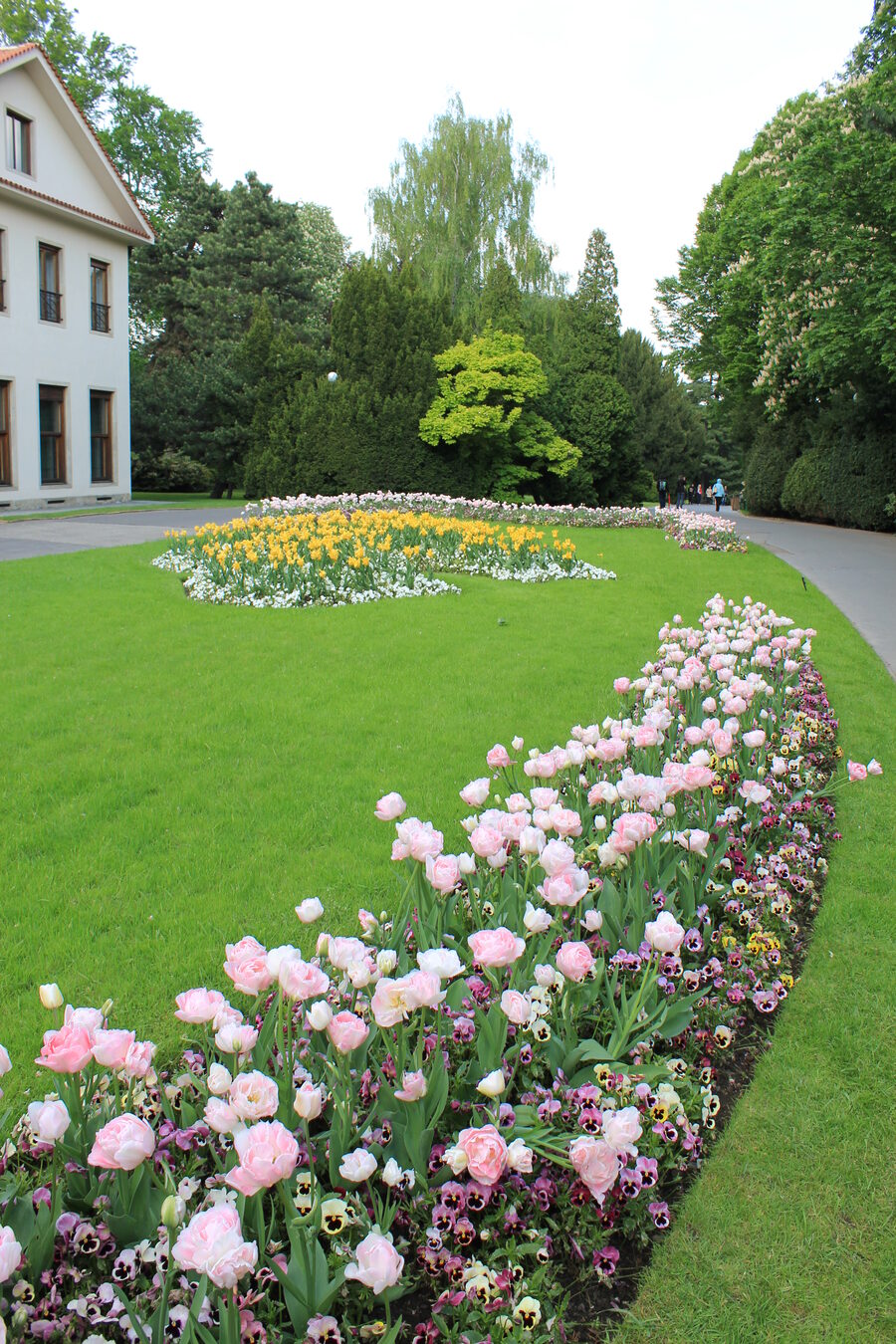
Created in 1534 by Ferdinand I, the Royal Garden lies north of the castle complex across a narrow ravine called the Stag Moat (now a walking path). It's a Renaissance garden with formal flower beds, tulip plantings (Prague's tulips were noted as among the finest in Europe in the 16th century), and views back toward the castle's north face.
The garden contains two notable buildings: the Summer Palace (Belvedere, 1538–1563), the first pure Renaissance building constructed north of the Alps, and the Ball Game Hall (1568), built for court sports and now used for temporary exhibitions. Both can be viewed from outside; interior access depends on current exhibitions. The garden is quieter than the main castle grounds and has benches.
Notable inside
- Summer Palace / Belvedere (1538)
- Ball Game Hall (1568)
- Formal tulip and rose beds
- Views across to castle's north face